 da
 en


- Frontpage >
- Plant Encyclopedia >
- Pheasant's Eye Narcissus
Pheasant's Eye Narcissus
- Latin name: Narcissus poeticus
- Type: Flower, bulb plant
- Light conditions: Full sun, partial shade
- Soil conditions: Ordinary, well-drained
- Other: Herald of spring
Recommended Products

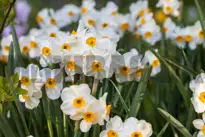
The pheasant's eye narcissus (poet's narcissus) is a beautiful spring-flowering bulb known for its fragrant white flowers with a striking corona in the centre. It is not only an ornamental flower – its strong scent and classic appearance also make it well suited as a cut flower. Its ease of cultivation and reliable spring flowering make the pheasant's eye narcissus a favourite in Danish gardens.
The pheasant's eye narcissus thrives in good-quality, well-drained soil. It prefers a slightly acidic to neutral pH value. The bulbs should be planted in light, moist soil, but they also tolerate dry periods when the plant is dormant. Adding organic matter such as compost when planting will improve the soil structure and provide nutrients for the bulbs.
The pheasant's eye narcissus thrives best in full sun or light shade. It needs at least 6 hours of direct sunlight a day for optimal flowering. In shady areas, it can still grow, but flowering may be sparser. The bulbs should be planted in autumn so that they can build up strength before flowering in spring.
5 widespread types of pheasant's eye narcissus in Denmark:
- Narcissus poeticus 'Actaea': A variety with white petals and a small yellow corona with a red rim, known for its scent.
- Narcissus poeticus var. recurvus: A variety with swept-back petals and a distinctive red rim around the corona.
- Narcissus poeticus var. radiiflorus: A variety with radiating petals and a small corona.
- Narcissus poeticus 'Pheasant's Eye': A variety with delicate white petals and a small yellow corona with a red eye.
- Narcissus poeticus var. poetarum: A variety with elegant white petals and a small yellow corona with a red rim.
This guide is for guidance only. Landscaping and gardening is not an exact science, and a successful result can be affected by many variables, including (but not limited to): soil conditions, location, watering, temperatures, weather, application of fertiliser and mulch, and much more.